What is Machine Translation?

Machine translation (MT) is the use of automated software that translates text without human involvement. Adaptive MT is a technology that learns and adjusts in real-time from human feedback, increasingly using artificial intelligence (AI).

Based on probability, not meaning.

Machine translation doesn’t understand the meaning or the context of what it’s translating.

Provides the best guess without verification.

Machine translation only guesses the most likely translation. If you cannot read both languages, you will never know if it has guessed correctly.

Saves time and money?

Getting your message wrong can cost money, ruin your image, and even cost lives. It pays to hire a professional to get the job done right.

The Dangers of Artificial Intelligence:

Misleading Accuracy, Questionable Data Sources, and Confidentiality Concerns

As AI pulls from uncontrolled, unverified, or even manipulated sources, the risk of spreading misinformation, inaccuracies, and flawed communication rises.

This evolving landscape underscores the growing importance of professional translators and interpreters, whose expertise and credentials will be key in ensuring that, whenever AI-generated content is used, it is properly assessed, corrected, and validated.

Read ATA's Statement on Artificial Intelligence

When to use machine translation

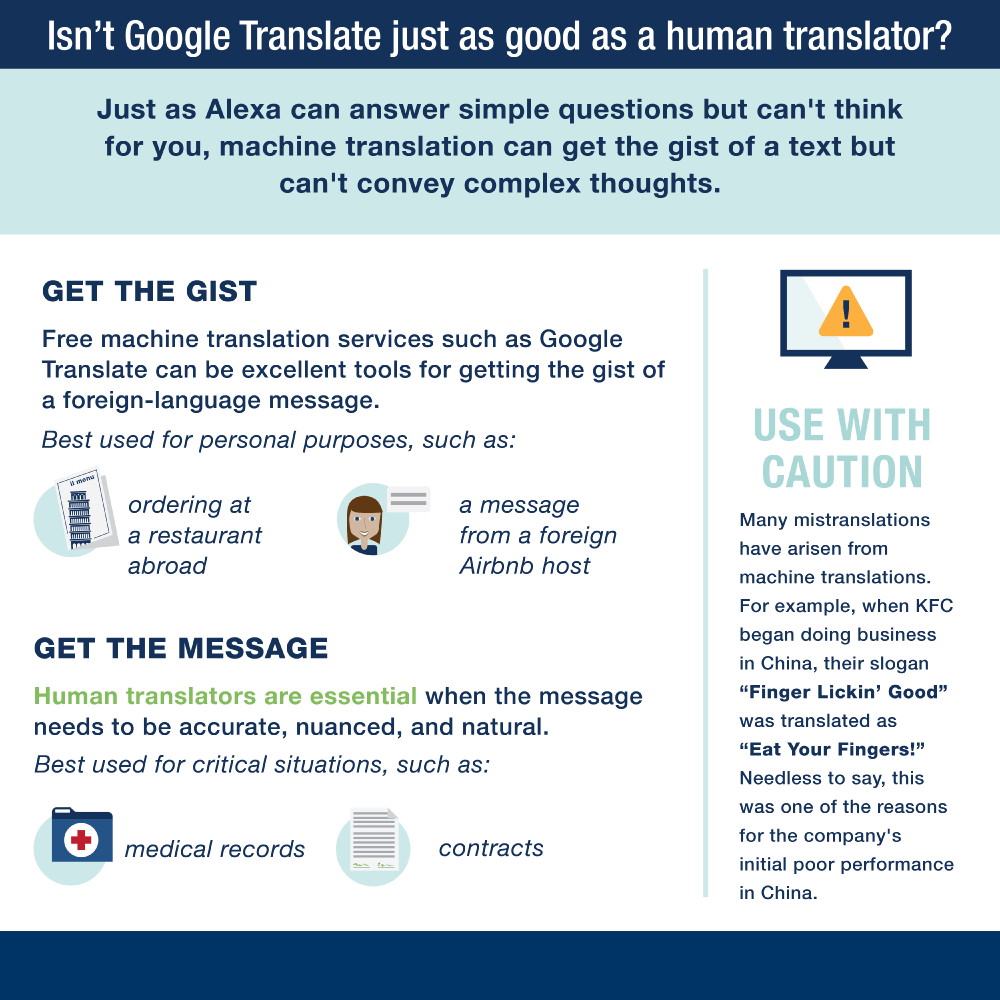
Generic MT services such as Google Translate, DeepL, or Microsoft Bing Translator can be excellent tools for gaining an approximate idea of what a foreign-language communication says.

For the casual user, "getting the gist" of the message may be helpful for ordering at a restaurant abroad or receiving messages from a foreign Airbnb host.

Customizable MT services can be trained to improve accuracy of terminology within a specific field such as medical, legal, finance, etc.

The output can be more reliable, especially if the original texts were prepped with relatively short sentences or very controlled terminology. However, post-editing by a professional translator will be required, unless errors and non-idiomatic style can be tolerated.

Caution: It may not be confidential

Content that is translated by free online MT services may be stored and analyzed to improve their results. If you are considering using an MT service, review the terms and conditions to ensure your data remains confidential.
machine-translation

When NOT to use machine translation

If the law, a life, or your bottom line is involved, relying on MT can have disastrous consequences.

The choice between MT and human translation depends on the kind of text you need translated and how important accuracy is to you, your company, and your customers.

With the right process in place, functional texts in common language combinations will yield adequate results by using a combination of MT and human post-editing.

Creative texts should be translated by a human. MT will not be able to render style, nuance, or idiomatic expressions.

Poor translation can be embarrassing or even disastrous for your business—endangering customers and putting your company at risk for lawsuits.

To explore this topic further, read ATA's Position Paper on Machine Translation: A Clear Approach to a Complex Topic.

Find a Professional Translator or Interpreter

When you are committed to quality, the language professional you need is an ATA member.

Need Help Finding the Right Professional?

Getting your message wrong can cost money, ruin your image, and even cost lives. It pays to hire a professional translator or interpreter to get the job done right.

Professional translators and interpreters can help you reach more customers, grow your business, and improve your bottom line.

Why Should I Hire a Professional?

Read More
Translator vs. Interpreter: What's the difference?

Translator vs. Interpreter

Read More
ATA's Language Services Directory makes it easy to connect with professional translators and interpreters who are ready to assist you.

Find a Translator or Interpreter Near You

Read More
ATA offers free guides to help you navigate the process of hiring and working with a professional translator or interpreter.

Buying Language Services

Read More
Want to reach more customers, grow your business, and improve your bottom line? Learn how language professionals can help.

The ATA Compass

Read More
When it comes to effective communication across languages, the expertise of a certified translator or interpreter can make all the difference.

Why You Should Use a Certified Translator or Interpreter

Read More
ATA certification is a respected credential, providing evidence of the knowledge and skills necessary to provide a quality translation.

Guide to ATA Certification

Read More
Discover how professional language services experts can bridge linguistic gaps and facilitate seamless communication.

Exploring Translation and Interpreting Services

Read More
Understand the common uses and requirements of a certified translation and download sample statements.

What is a Certified Translation?

Read More
Find the translator or interpreter that meets your needs. Customize your search by language, specialties, location, credentials, and more.

Language Services Directory

Read More
Know Your Rights to Language Access

Know Your Rights to Language Access

Read More
Reach new audiences, communicate with confidence, and gain a competitive edge with the help of a language professional.

Client Assistance

Read More