

Professional Medical Interpreters: Four Signs of a True Pro

If you work in healthcare, chances are you’ve encountered limited English proficiency (LEP) patients who aren’t fully comfortable communicating in English. When no professional interpreter is available, it’s tempting to turn to whoever is bilingual in the room, such as a staff member or family member. But bilingual doesn’t equal qualified, and a well-meaning but untrained interpreter can have a detrimental impact on patient outcomes. Whatever your current setup, knowing what a trained medical interpreter looks like in practice can make a real difference. Here are four signs you’re working with a true professional.
Why professional medical interpreters make a difference
- We relay everything that is said, and not just what seems relevant
Any interpretation assignment will have at least one Limited English Proficiency (LEP) individual, who may or may not be the patient. For example, a pediatric visit might include a bilingual patient whose parent, the LEP, only speaks Spanish.
Some brand-new interpreters think they only need to relay what the provider says to the LEP and can stay silent otherwise, such as when the provider asks the child questions in English. However, interpreters are bound by ethics to interpret everything that is said, without omitting or adding any key information. As an interpreter, it’s not up to me to decide which speech is relevant and which is not. Rather, my goal is to make the interaction seem as if you and the LEP knew the same language and culture.
So, while medical interpretation is usually performed in consecutive mode (with each speaker pausing after each sentence or two for the interpreter to speak), the scenario above requires the simultaneous mode, in which I am listening to what the pediatric patient is telling the doctor in English and relaying it simultaneously in Spanish to the LEP.
- We understand the subject matter, but admit limitations gracefully
A professional medical interpreter brings both specialized medical knowledge and the judgment to recognize when something needs clarification. We are well-versed in both medical terminology and everyday terms in both languages. On the few occasions when we have to look up slang, regional terms, or ambiguous meanings, we can admit our limitations by double-checking our dictionary app or asking the patient for clarification.
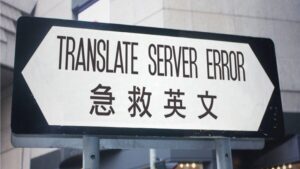
By contrast, a machine translation service like Google Translate will confidently output a translation without being able to recognize slang, regional variation, or ambiguity. It can’t tell when a term might have multiple, equally possible options. For example, Google Translate will simply translate gripe as “flu” because that is the official definition in Spanish, but Spanish speakers will often colloquially say gripe to mean a cold instead. So, as the interpreter, I have to assess the intent before deciding whether to interpret “Hoy traigo gripe” faithfully as “I have a cold today” or “I have the flu today.” In other words, machine translation services can cause misunderstandings and even safety concerns that a trained human professional can anticipate and avoid.
Interpreters are sometimes asked to read a document on the spot and interpret its contents orally, what we call sight translation. A bilingual staff member or family member may be too inexperienced to A) read, understand, and relay the information accurately or B) admit that they can’t. Meanwhile, a professional knows what’s at stake and follows professional ethics. For example, unlike many laypeople, we understand that translation (written) and interpretation (spoken) are two very different disciplines. I’m happy to sight translate a short consent form or informational brochure, but for lengthier documents such as legal privacy policies, I will politely decline to sight translate and ask the provider to summarize it instead so that I can interpret what they say to the patient.
- We have the right training
Formal interpretation training provides an ethical framework and a set of best practice procedures for interpreters. It lets us effectively use our language skills and cultural knowledge to help providers and patients while preventing ethical or safety concerns. Training can mean a community course like Bridging the Gap; a higher-level certification from organizations like the National Certification Commission for Healthcare Interpreters (CCHI), the National Board of Certification for Medical Interpreters (NBCMI), or The Registry of Interpreters for the Deaf (RID); or a college degree in interpreting. But it’s important to note that interpreter training does not include a college degree in translation or a foreign language. As mentioned above, translation and interpreting are different disciplines with distinct skillsets, and not all language professionals are proficient in both.
Many medical providers working with an LEP patient for the first time try to have a family member interpret. However well-intentioned this practice is, CCHI and other agencies strongly recommend against it. Untrained ad-hoc interpreters, especially children, can lack the specialized vocabulary or the memorization skills needed to accurately convey information, and they have not been trained on ethical guidelines. Placing the burden of this work on untrained individuals rather than on language professionals can lead to miscommunication and potential harm.
That said, many professional interpreters start out volunteering for family members or neighbors, become motivated to get into this career, and then seek proper training. If your interpreter has this kind of background, that’s a great sign that they are motivated by empathy and have everyone’s best interests at heart! It’s simply important to remember that proper training matters just as much as empathy for doctors and other medical professionals—and the same applies to language professionals.
- We follow best practice procedures
Trained interpreters have learned best practices to keep the focus on the conversation and support transparency:
- We position ourselves between the LEP and provider, while avoiding eye contact with either of them.
- We speak in first-person, convey emotion in our voices, and ensure that the dialogue remains between the provider and the LEP. For instance, if a provider says, “Tell the patient that I’d like her to schedule a follow-up in two months,” I would ask them to redirect to the patient and say, “I’d like you to schedule a follow-up in two months,” which I will relay exactly. This speeds up the appointment and reduces possible confusion.
- We only join the conversation when both the provider and LEP are present. This means that we stand outside the room when the provider isn’t there, to discourage both the LEP and provider from trying to ask something “in confidence” out of the other person’s earshot.
- We know when to ask for breaks. Accurately interpreting everything means fewer opportunities to rest during the session. That’s why a good interpreter will also pay attention to their own energy levels and ask for breaks when necessary to prevent errors caused by fatigue. The industry recommends interpreters take a break after every 60-90 minutes for consecutive interpretation and every 30 minutes for simultaneous, since the latter mode is even more challenging and mentally tiring than the former.
The value of professional medical interpreters
The four signs outlined above share a common thread: professional medical interpreters are trained, ethical, and accountable. We bring specialized knowledge and professional standards that protect both patients and providers. The result: clearer communication, fewer errors, reduced legal risks, and better patient outcomes, including greater patient safety and dignity. When you work with qualified interpreters, everyone in the room benefits. If your organization is relying on bilingual staff or patient family members to fill this role, consider these four signs your roadmap for what a true professional looks like—and why it matters.
About the author
 Hannah Varadi is an ATA-certified Spanish to English translator specializing in legal, medical, and literary content. She is also a CCHI-certified Spanish medical interpreter with over a decade of hands-on experience. The American Translators Association represents almost 9,000 translators and interpreters in more than 100 countries. To hire a translation or interpreting professional, please visit www.atanet.org/directory.

Subscribe to The ATA Compass
Connect with The ATA Compass
Recent Posts

Why Hire an ATA-Certified Translator®?
What is ATA Certification? Respected credential ATA certification is one of the industry’s most respected and recognized credential for translators. It is also the only widely recognized measure of translation…
Why Should I Hire a Professional?
It takes more than just the ability to understand two languages. Professional translators and interpreters have the education, experience, and expertise to understand the nuances in one language and transfer…
The ATA Compass
Want to reach more customers, grow your business, and improve your bottom line? The ATA Compass publishes articles and provides resources to show you how language professionals can help you…

Verify ATA-Certified Translator® Status
Enter a certification number and click to verify! Note: You cannot verify certification with a membership number. You must enter the translator’s certification number. What is the ATA Certification Program?…

Client Assistance
Need Help Finding the Right Professional? Getting your message wrong can cost money, ruin your image, and even cost lives. It pays to hire a professional translator or interpreter to…

Machine Translation
What is Machine Translation? Machine translation (MT) is the use of automated software that translates text without human involvement. Adaptive MT is a technology that learns and adjusts in real-time…