

Empowering LEP Communities with Language Access Cards

Millions of people in the United States have limited English proficiency (LEP), which can create barriers when accessing healthcare, legal services, education, and other essential resources. To help LEP individuals request language support more easily, the American Translators Association (ATA) now offers Language Access Cards.
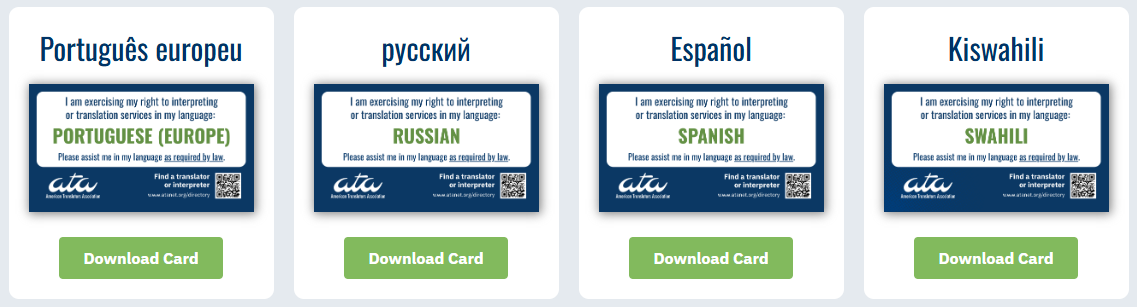
These cards are available for download in over a dozen languages (and counting). Anyone can use them, including LEP individuals themselves or organizations that assist LEP individuals. Cardholders can present the cards in settings like hospitals and courtrooms to request language assistance. The front of the card is in English and indicates that the cardholder is exercising their right to interpreting or translation services in their language. It indicates the language and requests assistance in that language. On the back, users find instructions for how to use the card in their language. The card also includes a link to ATA’s Language Services Directory, where service providers can find a professional interpreter or translator. Anyone who needs help understanding the process of hiring and working with a professional interpreter or translator will find ATA’s free guides very useful.
The project was initiated by ATA’s Public Relations Committee to support LEP individuals in the United States, particularly as many have faced growing challenges to language access in recent years.
The ATA Compass spoke with ATA Public Relations Committee members Jamie Hartz and Olivia C. Caputo to learn more about this project and how the cards help LEP individuals understand their rights, improve language access, and connect them with qualified interpreters and translators.
Continue reading to learn:
- Why language access is critical in everyday life
- How to use the Language Access Cards
- How translators and interpreters provide solutions to language access challenges
LEP and Language Access: Breaking Down the Basics
Who is considered Limited English Proficient (LEP)?
JH: LEP is a term used to refer to individuals who have a limited ability to read, write, speak, or understand English. Often, English is not their primary language. Many LEP individuals are immigrants or refugees, but many American citizens, such as people born in Puerto Rico or the many indigenous communities across the country, may also be LEP because they speak a language other than English at home or in their everyday lives.
What does “language access” mean?
OC: Language access means being able to access services in a language you understand or in which you are more comfortable communicating. In the United States, even if you speak some English, that language might be your native tongue.
As ATA explains, LEP individuals “have equal access to government services and programs and cannot be discriminated against based on national origin or limited English skills. […] If an agency or organization does not assist those who are LEP, it may be violating the law.”
Language access can come from private or public sources. For example, you may see signs at your local bank or pharmacy that say something like “se habla español.” This reassures and can attract Spanish-speaking customers, who may not feel comfortable discussing financial matters in their non-native language. In some cases, language access is legally required. The New York State Unified Court System is legally obligated to provide an interpreter for any court user who requests it, regardless of their level of English proficiency.
Language access is best provided by professional interpreters (spoken word) or translators (written word).
When the Stakes are High: Professional Translators and Interpreters Mean Equal Access
Why is language access so important?
JH: Those of us who grew up speaking English at home or speak it proficiently take it for granted, but there are many situations and settings where language access is critical in everyday life. Some of the most common include courts and medical settings. Life-altering decisions are often made in these settings, requiring extreme caution and a thorough understanding of what is going on. And it is precisely in these settings that individuals are more likely to experience high stress, encounter complex terminology, and interact with people they don’t know, all of which make it harder to accurately express themselves or follow along in a language that is less familiar to them.
Why are professional translators and interpreters critical in language-access situations?
JH: Translators and interpreters are exactly the people LEP individuals want in their corner for language access! These professionals not only have the linguistic know-how to bridge the language gap but also the experience, expertise, and competence to make it seamless. In the United States, LEP individuals must navigate many complex systems. Professional translators and interpreters offering language access services help to decrease liability risk, improve efficiency, and uphold the human dignity of the populations they serve.
Using ATA’s Language Access Cards to Request Language Services
How does one use a Language Access Card?
JH: ATA’s Language Access Cards are available as PDF files, which you can download here: www.atanet.org/language-access. Simply locate your language and click the “Download Card” button. You can download the PDF card to your phone or take a screenshot. Save it in a safe place that will be easy to access and find on your phone, like a favorites folder or digital wallet. Alternatively, you can print out the wallet size cards and cut them out to keep hard copies in your wallet or purse. Whether you carry the card in your phone or wallet, remember to show the card next time you are in a situation where you wish to exercise your right to interpreting or translation services, like the doctor’s office or at your child’s school.
Are the Language Access Cards available in all languages?
OC: ATA currently has cards available for the following languages, based on the languages most spoken in the US plus a few that were volunteered by ATA translators:
- Arabic
- Cantonese and Mandarin (simplified and traditional)
- Dari
- Farsi
- French
- Haitian Creole
- Japanese
- Korean
- Portuguese (Brazilian and European)
- Russian
- Spanish
- Swahili
- Tagalog
- Tajik
- Ukrainian
- Uzbek
- Vietnamese
What if my language isn’t available? Can I request a card in my language?
OC: Absolutely! Contact us by emailing the Public Relations Committee if you don’t see your language, especially if you’re a translator and would like to offer a translation in your native language. If you aren’t a translator, ATA will do its best to find a qualified ATA member to translate the card into your language.
What other resources are available on the ATA Language Access webpage?
OC: Some of the resources listed are language access plans, some are non-profits that help LEP individuals, and some are health insurance companies that have language access responses in place. Basically anything to help people get this access at the state level, which is where it’s most likely to come from, at least for now.
How it all Started: The Backstory of ATA’s Language Access Cards
How did the idea for ATA’s Language Access Cards originate?
JH: ATA is a strong advocate for language access rights. ATA’s Public Relations and Advocacy Committees wanted to have a tool that would benefit both the LEP individuals served by our members and ATA members themselves. The cards are a simple and effective way for LEP individuals to be informed of and exercise their right to professional translation and interpreting services. Furthermore, with the recent changes in the implementation of language access rights, now is a critical time to provide a new resource that makes sure folks understand their rights and can avail themselves of these rights easily.
What is the goal of the Language Access Cards?
OC: Throughout the project, Jamie and I repeatedly said that our ultimate goal was to create something that would be actionable and useful, even in a changing landscape. The fact that the cards say, “You may have the right to language assistance at no cost…” is a reflection of recent cuts to language access at the federal level. We wanted to give people a way to advocate for themselves, even knowing that the help they’re offered may not be enough. That’s something we can’t control, but many people don’t even realize that they could have the right to an interpreter or translator in certain situations, and not all organizations will offer them unless asked. We wanted to at least facilitate that first step of seeking out the help and to give people a place to go to find more resources if needed.
How are the Language Access Cards translated?
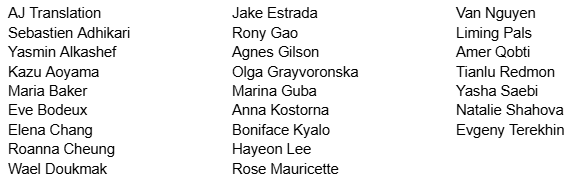
OC: The cards were translated by wonderful volunteers from ATA — fellow professional translators who are native speakers of the target language. We reached out to specific language divisions of ATA, leveraged personal connections, and used the ATA directory to put out a call. The response was overwhelming and very heartening; so many people wanted to help and because of that we are able to offer so many languages right from the start with more on the way.
Jamie and I coordinated the translations; we’d have one person translate and another person proof/edit the cards to make sure everything looked correct. It was a lot of emailing back and forth, Google docs galore, and an incredibly large Canva file, but it was worth it.
We are immensely grateful for all the volunteers who contributed their language expertise to this project!
Language Access is Vital – Use and Share the Cards
ATA will promote the cards on its social channels in the near future and welcomes any support to spread the word to LEP individuals. Olivia shares that “continuing to ask for language access in various settings, as well as proving that there are providers ready and able to facilitate it, is a good reminder to institutions that this is a vital need and should be a fundamental right.”
Language access is essential for ensuring equitable access to services and protecting the rights of individuals with limited English proficiency. Tools like ATA’s Language Access Cards help bridge communication gaps by making it easier for individuals to request professional interpretation or translation services when they need them most.
Visit ATA’s Language Access page and download your Language Access Card today! To find a professional translator or interpreter, visit ATA’s Language Services Directory.
About the Author
 Meghan McCallum is an ATA-certified French to English translator and writer specializing in corporate communications, marketing, and international development. She is also an active volunteer for the American Translators Association. The American Translators Association represents almost 9,000 translators and interpreters in more than 100 countries. To hire a translation or interpreting professional, please visit www.atanet.org/directory.

Subscribe to The ATA Compass
Connect with The ATA Compass
Recent Posts

Why Should I Hire a Professional?
It takes more than just the ability to understand two languages. Professional translators and interpreters have the education, experience, and expertise to understand the nuances in one language and transfer…

Buying Language Services
Guide to Buying Translation Services Translators help power the global economy, working with businesses, governments, non-profits and individuals. Translators work with the written word. The ATA Guide to Buying Translation…

Machine Translation
What is Machine Translation? Machine translation (MT) is the use of automated software that translates text without human involvement. Adaptive MT is a technology that learns and adjusts in real-time…

What is a Certified Translation?
What are the basics of a certified translation? In the United States, anyone can certify a translation. A translator does not need to be certified in order to provide a…

Translator vs. Interpreter
Watch a Day in the Life of Translators and Interpreters See how translators and interpreters work in this short animated video. Translators do the writing Translators work with the written…

Exploring Translation and Interpreting Services
Why Are Language Services Essential in an Internationalized World? In a world where communication knows no bounds, effective language services are paramount. ATA helps you find professional translators and interpreters…