
What's Happening Now?
ATA provides a snapshot of the current news, events, articles, podcasts, and more. ATA members receive a monthly e-newsletter that highlights this vital information.
Drum roll, please…We’re excited to announce this year’s ATA67 keynote speaker: Joachim Lépine!

Joachim Lépine
The best-selling author will share his passion for reclaiming human value and developing AI resilience.
As AI reshapes the world of work, how are the knowledge professions adapting? And what does this wave mean for translators? Are we going to be OK? This keynote addresses these questions head-on, examining content generation, professional adaptation, value redefinition, and AI resilience. Moving beyond mere “bouncing back,” we’ll draw inspiration from diverse sources to craft a vision for “bouncing forward.” In a noisy world, language professionals have a vital role to play. We are the signal amid the noise—the catalysts for better understanding, greater cooperation, and a brighter future. It’s time to claim our value and bounce forward.
It’s just one more reason to join us at ATA67 in San Francisco!
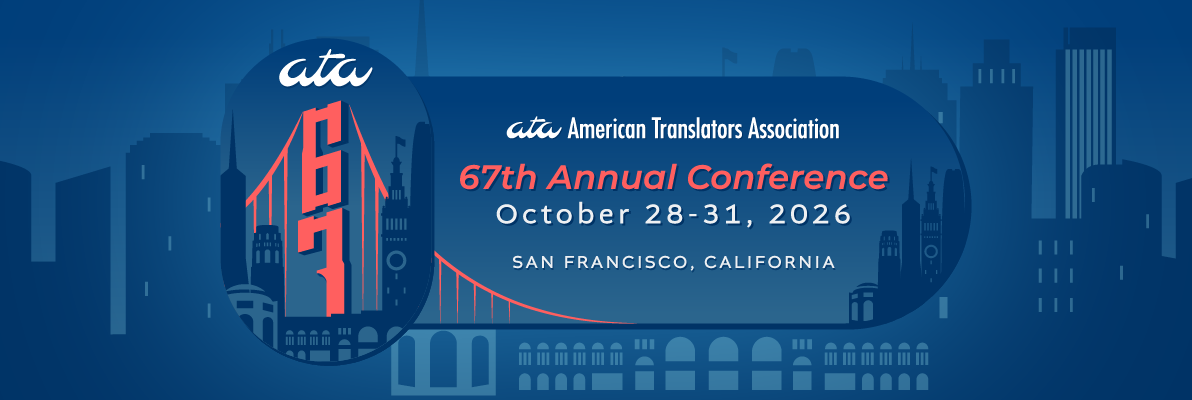
Our most anticipated event of the year is now open for registration!
Join us for ATA’s 67th Annual Conference in stunning San Francisco. For all language professionals, #ATA67 is your opportunity to stay in the know, plan for the future, and build connections with your community.
You’ll earn continuing education credits and future-proof your career with more than 110 curated sessions covering specializations, business practices, grammar and style, technology, and more! Between learning, you can network with the best and brightest in the industry and explore the heart of one of the world’s most diverse and vibrant cities. Check out the schedule at a glance for what to expect and get inspired to attend with our ATA67 promo video.
Register now and take advantage of early registration rates. The earlier you register, the more you save (and the longer you’ll have to look forward to attending)!
Stand Out at ATA67 as a Sponsor or Exhibitor
ATA67 puts you in front of 1,000+ language services experts shaping the future of T&I! Connect with them, as well as our entire membership, before, during, and after the conference as a sponsor or exhibitor. This is your opportunity to market your company, find top talent, and demonstrate your commitment to excellence.
Get special in-person access to thought leaders and decision-makers looking for solutions. Find new partners and generate bold ideas! When you sponsor or exhibit at ATA’s Annual Conference, you’ll be able to sell your solutions, generate leads, and amplify your brand. Visit the exhibitor and sponsor pages on the conference website to find options for any budget.
Have questions? Download the Prospectus or contact Kim Munroe at exhibit-sponsor@atanet.org to explore your options.
Become a Sponsor! Become an Exhibitor!
ATA actively works with government agencies and organizations on the issues that affect you. Through ATA's advocacy efforts, you will benefit from the success we achieve together. Being an ATA member supports these efforts.


Two senators are teaming up on a bill to codify language access standards for federal services after the Trump administration revoked a longstanding policy requiring agencies to make services accessible for people with limited English proficiency.
Senators Andy Kim and Mazie Hirono introduced the Language Access for All Act of 2026. The bill would require agencies to ensure individuals with limited English skills can “meaningfully access” federal programs, including through translation and interpreting services.
That had been the federal government’s policy for 25 years under an executive order signed by President Bill Clinton in 2000. But last year, President Trump signed an executive order revoking Clinton’s directive and declaring English as the “official language” of the United States.
“There’s nothing more basic to the purpose of government than to help people,” Kim said in a statement. “From accessing veteran benefits to helping file taxes, no one in our country should be barred from accessing critical assistance or resources because of language barriers. As the Trump administration goes after long-standing translation and language accessibility services, this legislation would make sure no president can stand between the American people and the agencies there to serve them.”
The legislation would also create a public complaint system for people who experience language access barriers to federal programs. It would require agencies to designate a language access coordinator and maintain language accessibility plans.
It would also establish technical standards for language access across government, including for AI and automated communications. The bill would bar agencies from fully replacing qualified translators and interpreters with AI-assisted services.
“In limiting multilingual access to federal resources, the Trump regime’s extreme anti-diversity ideology is preventing millions of American citizens from accessing critical services, including small business loans, Social Security benefits, and Medicare coverage,” Hirono said. “By protecting interpreter and translation services, this legislation ensures that all Americans, no matter what language they speak, can get the services they need.”
Federal News Network (7/15/26) By Justine Doubleday
A new state audit has found that the Oregon Department of Corrections and the Oregon Youth Authority are failing to meet the basic needs of people in custody with limited English proficiency, leading to isolation and gaps in medical care.
The Oregon Secretary of State audit of both corrections systems focused on how the agencies respond to people in state custody whose primary language is not English or who use sign language.
Auditors noted the implications for the communications breakdown, writing that it can lead to “disparate outcomes in health, safety, and civil rights.” Language access, the audit says, is “a fundamental component of delivering fair and accessible public services.”
The Youth Authority has nearly 800 youths and young adults on its caseload. That covers a mix of people who are in juvenile prisons and those on parole or probation. An estimated 12,000 people are in the state’s adult prison system.
“People in state custody with limited English proficiency should not receive worse care simply because they can’t communicate as well with the people responsible for their health and safety,” Oregon Secretary of State Tobias Read said. “If Oregonians are able to get the treatments and rehabilitation they need in custody, we all benefit when they return to their communities.”
The audit called out both agencies for failing to collect data on whether they are complying with state law. For instance, auditors found that neither agency reports compliance with state requirements related to the use of medical interpreters. The Department of Corrections documents such instances in handwritten logs, making it difficult for the agency to review and analyze. The Youth Authority, meanwhile, tracks requests for interpreters but not how often they are used.
“As a result, neither agency can provide a complete picture of how often interpreters are used, whether those interpreters are bilingual staff or contractors, and whether they are certified when used in healthcare settings,” the audit noted. “They also cannot provide documentation for compliance with requirements.”
In a letter to the audits division, Corrections Director Michael Reese said that while people with limited English proficiency make up a small percentage of the prison population, “their ability to complete assessments, understand processes, and participate in programs are no less important.”
Reese said the agency had already begun to add signs and expand staff training “to ensure language needs are consistently identified, documented, and addressed across the agency.”
The Chronicle (7/29/26) By Mark Graves
According to findings from a study presented at the Federation of European Neuroscience Societies conference in Barcelona, people who speak more than one language seem to have younger brains, and the more languages you speak and the earlier you speak them, the better.
While previous research had observed that people from European countries with greater language proficiency tended to age more slowly, this study measured the impact of speaking languages on individual brains. Scientists in Spain, Chile, Argentina, and Dublin compared people living in the Basque region, characterized by high levels of multilingualism, who spoke Spanish, Basque, French and/or English.
Lucia Amoruso, from the Basque Center on Cognition, Brain and Language in San Sebastián, said: “In simple terms, people who spoke more languages tended to have brains that looked younger than expected for their chronological age. The effect was not only related to the number of languages spoken. Higher language proficiency and earlier acquisition of a second language were also associated with more delayed brain aging. This suggests that multilingual experience matters as a gradient: it’s not simply about being bilingual or not, but about the depth and duration of language experience.”
Researchers considered factors such as people’s age, gender, and education, but cautioned that they could not rule out the potential influence of other factors that may have an impact on the brain, such as lifestyle and social engagement.
Responding to the findings, Christina Dalla, a neuroscientist from the National and Kapodistrian University of Athens, said: “This study suggests that learning a second, third, or fourth language could help our brains to stay younger for longer, and the earlier we start, the better. There are many good reasons for learning another language at any age—social, cultural, and for the health of your brain—so we should support language-learning at school and throughout life, even if it’s hard.”
But Eef Hogervorst, a professor of biological psychology at Loughborough University, urged caution. While the evidence did suggest being multilingual was associated with better brain resilience, she said, “it may be the case that people who speak multiple languages also engage in healthier lifestyles and/or have better access to other protective environments and activities, such as reading, lifelong learning, and playing musical instruments.”
BBC (7/6/26) By Anna Bawden
Housing rights organizations in Los Angeles are suing the city’s public housing agency. The suit accuses the Housing Authority of the City of Los Angeles (HACLA) of denying language assistance to limited-English-speaking clients.
The plaintiffs, including two low-income tenants, say HACLA’s failure to provide language services violates state law and puts their housing status at risk.
“When I received related notices or met with my caseworker, I was not properly provided with interpreting, let alone translated documents,” said Hyun Joo, one of the two tenants involved in the suit. “Even when I went in with an appointment,” she added, speaking in Korean, “if I could not communicate in English at the front desk, there were times when I had to wait indefinitely in the lobby or could not meet my caseworker at all.”
The Legal Aid Foundation of Los Angeles (LAFLA), the Law Office of Autumn Elliott, and the Western Center on Law & Poverty filed the lawsuit in May against HACLA and its president, Lourdes Castro Ramírez.
The Korean Resource Center is listed as a co-plaintiff in the suit. The organization says it has been forced to expend resources helping families denied language support by HACLA.
The lawsuit claims HACLA violated California Government Code Section 11135, which prohibits discrimination in programs funded by the state, and the Fair Employment and Housing Act, which bars discrimination specifically in housing and employment.
Heeyoung “Linda” Park is the LAFLA attorney handling the case. She said while HACLA’s website and its own internal policies state that professional interpreting services should be provided, in practice that was often not the case.
Clients, including Joo and her co-plaintiff, Eva Oceguera, who is originally from Mexico, were therefore forced to rely on English-speaking relatives. In Joo’s and Oceguera’s case, that meant their school-age children.
“The practice of telling people to bring minor children or acquaintances as interpreters also violates HACLA’s own policy and language access obligations,” Park said, noting the legal complexities of Housing 8 rules and requirements. “If they are misunderstood, a person could lose housing assistance.”
In response to the lawsuit, HACLA said in a statement that it is “dedicated to doing all we can to meet the needs of our community and uphold our values around inclusivity and accessibility, including language access.” HACLA also said its Board of Commissioners approved a revised language access services policy in June, adding that the policy “reflects our ongoing commitment to ensuring access and information for our diverse population.”
ACOM (7/10/26) By Nicole Chang
Sir Christopher Nolan’s latest film, The Odyssey, may have won rave reviews from critics but one person is definitely not happy.
Emily Wilson, the academic whose 2017 translation of Homer’s The Odyssey was cited by the director as an influence on his adaptation of the poem, has written a scathing review of the movie.
Published in the London Review of Books, Wilson said she “would be ashamed to have written any of this script,” describing the film’s narrative structure as “gimmicky.”
“The writing is abysmal,” she said. “None of the characters has convincing motivation for their actions or words. It lacks psychological, emotional, political, and ethical depth.”
Despite this criticism, Wilson acknowledged that Nolan’s work had sparked renewed interest in Homer’s classic. “The release of The Odyssey is still an event to celebrate,” she wrote. “This epic is bringing audiences back to cinemas…translations of The Odyssey, including mine, are flying off the shelves…[and] perhaps the film will persuade a few college administrators not to cut their literature, language, and history departments.”
BBC (7/28/26 ) By Emma Saunders
More T&I News
North Carolina Court Interpreter Walkout Begins. Could Court Proceedings Be Affected? | WRAL
Spain Faces EU Court Over Disputed Rules on Professional Qualification Recognition | The Brussels Times Newsroom
The Translator's Voice: Michael Katz on Translating Fyodor Dostoevsky’s The Idiot | Chicago Review of Books
Dual Language Signs Now Posted for All Federally Recognized Tribes in Wisconsin | WXPR
Why Learning a Language Still Matters | TIME
In Praise of the Translators Who Transport Us Across the Globe | Publishing Perspectives

ATA will hold its regularly scheduled elections online in October to fill the following positions:
• Treasurer (one position for a one-year term)
• Director (three positions, each for a three-year term)
The candidates proposed by the Nominating and Leadership Development Committee are listed below. (Note: Article VII, Section 2, d.2) of ATA’s Bylaws states that the committee “shall propose multiple candidates for each elective position of the Association….”)
Treasurer (one position for a one-year term)
Marian S. Greenfield
Stephen Lank
Director (three positions, each for a three-year term)
María (Mila) Baker
Analia Bogdan
Meredith Cannella
Steven McGrath
Teresa C. Salazar
Gabriela (Siebach) Serrambana-Espinoza
The elections will be held online. Voting members will be sent their proxy voting information in early October. Candidate statements will be featured in the September/October issue of The ATA Chronicle and on ATA’s website.
Become an ATA Voting Member by September 22!
To participate in ATA elections, you must be a Voting member by September 22, 2026. You can become a Voting member by passing a certification exam, completing the Active Membership Review process, or successfully submitting proof of being a credentialed interpreter.

This webinar gives you a proven, down-to-earth negotiation toolkit to help you earn more with less stress. In today’s AI‑saturated world, negotiation remains one of the most powerful ways to…

Learn how to customize Claude using Projects, Skills, and Agents to ensure terminology accuracy and streamline quality assurance through automation. As a translator, you may have spent more time than…

Live from Shanghai, Adrian Dunbar shares the inside story of his appointment at the Shanghai International Studies University Graduate Institute of Interpreting and Translation. A decade ago, Washington launched the…

Calling all bookworms! ATA invites you to join our Business Book Club! We’ll discuss Ryan Holiday’s The Obstacle Is the Way. Join our guest host to take a step back…

The Membership Development Committee develops and supports initiatives aimed at membership growth and retention. Learn more about the Membership Development Committee. This is a closed meeting for committee members only.…

This space is dedicated to celebrating the accomplishments of our members!
Kate Deimling’s debut poetry collection, Time Traveling, was published by Cornerstone Press.
Submit Your Member News!
Do you have news to share with us? If so, you might be featured on our social media channels.

Writing Your Public Profile
In professional associations, you can often publish a public profile. Clients use this profile to decide who to work with. It should be brief, but it has to tell your…


Beyond Translation: The Value-Added Roles Translators Play
When you hire a professional translator, you’re bringing someone into your business who does far more than convert words from one language to another. Translators are skilled writers, cultural insiders,…

E117: What is the International Federation of Translators (FIT)?
From education to celebration, FIT supports the professions by hosting events, providing online education, and promoting International Translation Day.


The ATA Chronicle
ATA’s flagship publication since 1972 The ATA Chronicle is the official publication of the American Translators Association. Published six times per year, each issue offers resources and practical solutions to…
Free Monthly Webinar
ATA offers members a free webinar each month, available on-demand for 30 days. Don't miss this month's freebie!

Freelancer Retirement Planning: U.S. Accounts and Exit Tips
Wondering how to retire as a self-employed freelancer with a global life? Get a clear roadmap to U.S. retirement planning, savings strategies, and exit tax considerations tailored to translators, interpreters,…



Issues of Newsbriefs
Get the Member Advantage
ATA members are ready for any challenge with the support of a collaborative community, effective education, and 24/7 promotion in ATA’s Language Services Directory.
Get Noticed!
Advertise in Newsbriefs to reach ATA members each month. Consistently high open rates guarantee your advertising will be seen by thousands of professionals!