
What's Happening Now?
ATA provides a snapshot of the current news, events, articles, podcasts, and more. ATA members receive a monthly e-newsletter that highlights this vital information.

A new bill would help Colorado students get recognition at graduation for being fluent in more than one language.
Colorado lawmakers established a process in 2017 for districts to create a seal of biliteracy to be awarded at graduation. Students earn the endorsement if they show proficiency in English and another language through grades and tests.
House Bill 1028, which passed the House Education Committee, states that only 55 of Colorado’s 179 school districts offer a biliteracy seal. This disproportionately leaves out students in rural districts or small schools. The bill creates a new bilingualism diploma endorsement and expands the ability of schools to offer biliteracy and the new bilingualism endorsements.
Students in districts that haven’t created their own endorsement would still need good grades and to take tests measuring competency in English and another language. They would be able to work with a college, university, or a Colorado Department of Education-approved educational nonprofit partner to receive an endorsement.
State Representative Elizabeth Velasco said bilingual students live in every corner of the state, but too many can’t showcase their mastery. The endorsements help demonstrate students’ abilities to employers and colleges. “We want to make sure that kids are able to elevate their skills no matter where they live.”
The bill would require the Colorado Department of Education to set uniform statewide educational requirements for the bilingualism endorsement. Districts that don’t have a program could work with a college or educational non-profit for a fee.
Jorge Garcia, chair and chief executive officer of the Colorado Association for Bilingual Education, said during committee testimony that the current seal has helped students access scholarships and get the recognition they deserve for their abilities. His organization supported the 2017 law.
“In the spirit of continuous improvement, we see the opportunity for us to go even farther, the opportunity to increase access,” Garcia said.
Chalkbeat (2/5/26) By Jason Gonzales
The Florida Department of Highway Safety and Motor Vehicles (FLHSMV) has announced that all driver’s license tests will now only be issued in English.
FLHSMV said they are implementing the change statewide and will no longer allow interpreters for any of the oral exams or the printed tests. The change began on February 6 and will apply to all driver license classifications, including oral exams, FLHSMV said.
Previously, knowledge exams for most non-commercial driver license classifications were offered in multiple languages, while commercial learner’s permit and commercial driver license knowledge exams were only available in English and Spanish. Under the updated policy, all driver’s license knowledge and skills testing will be conducted in English.
To implement this change, FLHSMV has updated its driver license testing system statewide. Any printed exams in languages other than English will be removed from use.
“FLHSMV remains committed to ensuring safe roadways for all Floridians and visitors by promoting clear communication, understanding of traffic laws, and responsible driving behavior,” the department said in a statement.
CBS Miami (2/5/26) By Ana Maria Soler
ATA actively works with government agencies and organizations on the issues that affect you. Through ATA's advocacy efforts, you will benefit from the success we achieve together. Being an ATA member supports these efforts.

The government of New Brunswick, Canada, has entered the world of artificial intelligence (AI) with the implementation of a website called ChatGNB that’s available exclusively for government employees.
While there aren’t many details on exactly how it’s being used, the Department of Finance and Treasury Board, which has been piloting the program for the past year, said it’s mainly being used for translating internal documents. But this has some translators concerned.
“There are certain ethical considerations here that we should take into account, because translators fear that they may lose jobs, or that their source of income may diminish,” said Sergey Petrov, a certified translator and the president of the Corporation of Translators, Terminologists and Interpreters of New Brunswick.
Petrov said many of the corporation’s 110 members are individual contractors, and some may get less work if AI is used in their place. “It can make your work a lot easier, but there are some valid concerns,” he said.
Government officials said ChatGNB was created with the support of the Office of the Chief Information Officer and that it’s being used because it’s more private and secure than other AI models out there. “The tool was developed to address the need for meeting privacy and security requirements not previously available from commercial services, while safely exploring benefits from AI,” said a statement from a representative with the Department of Finance.
The Department of Finance said that documents like collective agreements, contracts, policies, and external-facing documents will continue to be translated by Service New Brunswick’s translation services, even as AI develops.
Petrov said the government told the corporation that “employees are encouraged to review translations for accuracy and formatting.” But he doesn’t think that guideline goes far enough and said the corporation will be issuing a formal statement suggesting the government require AI translations to be reviewed and corrected by a real human.
“For me, this is an immediate red flag,” Petrov said. “Because if you want to produce something that’s intended for public use, or that has a serious nature such as legal documents, legally binding documents, or technical documentation or commercial documentation without a review, you are set for trouble sooner or later.”
Petrov said he thinks ChatGNB will open the door for AI to be used for more tasks. “There should be a human being in charge who can be held responsible for what they produce.”
CBC News (1/29/26) By Victoria Walton
Following a multistate demand letter to the Federal Communications Commission (FCC) in November 2025 led by New York Attorney General Letitia James, the FCC has published a long-delayed Multilingual Alerts Order in the Federal Register requiring the expansion of cell phone emergency alerts to include American Sign Language and 13 additional languages.
Wireless Emergency Alerts are short, text message-like alerts sent by government agencies through cell carriers to warn the public of imminent threats, including severe weather, natural disasters, missing persons, and other public safety emergencies. These alerts are among the most widely used public warning tools in the U.S., but for years were issued only in English, with Spanish only supported more recently.
Wireless carriers now have until June 12, 2028, to update their systems to support multilingual alerts in Arabic, Chinese (Simplified and Traditional), French, German, Haitian Creole, Hindi, Italian, Korean, Portuguese, Russian, Spanish, Tagalog, and Vietnamese, as well as American Sign Language. This expansion will benefit an estimated 1.3 million New Yorkers statewide who are not proficient in either English or Spanish and will now be able to access critical, life-saving information during emergencies.
“This is a profound victory for the millions of New Yorkers and families across the country who will no longer be left without guidance during emergencies and natural disasters,” said Attorney General James in a statement. “No one’s ability to protect themselves and their loved ones should depend on the language they speak. I am proud to have stood with my fellow attorneys general and advocates nationwide to push this rule forward. This language expansion will save lives.”
Office of the New York State Attorney (1/21/26)
The Florida Department of Highway Safety and Motor Vehicles (FLHSMV) has announced that all driver’s license tests will now only be issued in English.
FLHSMV said they are implementing the change statewide and will no longer allow interpreters for any of the oral exams or the printed tests. The change began on February 6 and will apply to all driver license classifications, including oral exams, FLHSMV said.
Previously, knowledge exams for most non-commercial driver license classifications were offered in multiple languages, while commercial learner’s permit and commercial driver license knowledge exams were only available in English and Spanish. Under the updated policy, all driver’s license knowledge and skills testing will be conducted in English.
To implement this change, FLHSMV has updated its driver license testing system statewide. Any printed exams in languages other than English will be removed from use.
“FLHSMV remains committed to ensuring safe roadways for all Floridians and visitors by promoting clear communication, understanding of traffic laws, and responsible driving behavior,” the department said in a statement.
CBS Miami (2/5/26) By Ana Maria Soler
A new bill would help Colorado students get recognition at graduation for being fluent in more than one language.
Colorado lawmakers established a process in 2017 for districts to create a seal of biliteracy to be awarded at graduation. Students earn the endorsement if they show proficiency in English and another language through grades and tests.
House Bill 1028, which passed the House Education Committee, states that only 55 of Colorado’s 179 school districts offer a biliteracy seal. This disproportionately leaves out students in rural districts or small schools. The bill creates a new bilingualism diploma endorsement and expands the ability of schools to offer biliteracy and the new bilingualism endorsements.
Students in districts that haven’t created their own endorsement would still need good grades and to take tests measuring competency in English and another language. They would be able to work with a college, university, or a Colorado Department of Education-approved educational nonprofit partner to receive an endorsement.
State Representative Elizabeth Velasco said bilingual students live in every corner of the state, but too many can’t showcase their mastery. The endorsements help demonstrate students’ abilities to employers and colleges. “We want to make sure that kids are able to elevate their skills no matter where they live.”
The bill would require the Colorado Department of Education to set uniform statewide educational requirements for the bilingualism endorsement. Districts that don’t have a program could work with a college or educational non-profit for a fee.
Jorge Garcia, chair and chief executive officer of the Colorado Association for Bilingual Education, said during committee testimony that the current seal has helped students access scholarships and get the recognition they deserve for their abilities. His organization supported the 2017 law.
“In the spirit of continuous improvement, we see the opportunity for us to go even farther, the opportunity to increase access,” Garcia said.
Chalkbeat (2/5/26) By Jason Gonzales
More T&I News
New Book Focuses on a Queer, Black, WWII-Era Translator Who Risked Safety for Love | NPR
New Sign Language Laws Will “Change Lives" | BBC
Doctoral Student to Translate English Professor’s Banned Novel from Persian to English | Binghamton University
Deaf Patients Condemn Lack of NHS National Health Service Interpreters | BBC

Thanks to rapid technological shifts and the global landscape of recent years, the demand for virtual interpreting services has increased. Virtual interpreting is a linguistic solution that allows people in different locations to connect with professional interpreters who help break down language barriers.
Virtual interpreting is used in a wide range of settings, the most common being healthcare, but also including education, business, and legal forums as well as conferences. Virtual interpreting can also be used under different modalities including over-the-phone interpreting (OPI), video-remote interpreting (VRI), or remote-simultaneous interpreting (RSI). Learn about the differences between VRI and VSI at the American Translators Association website.
Successful virtual interpreting is a shared responsibility between interpreters and the users of language services. This article will explore how interpreters prepare for their assignments, their requirements to be able to provide high quality interpreting, what clients and language service users should be aware of during interpreting sessions, and what both can do to get maximum benefit from the interpreting experience.
What is Required on the Part of the Interpreter?
Professional interpreters are ready to meet defined standards and are prepared to work remotely. When working for interpreting agencies or companies, interpreting professionals are required to comply with the following standards:
- Professional qualifications and training: This includes formal education or proven technical knowledge in interpreting, specialized training (the most common specializations being medical and legal), and familiarity with interpreting protocols and relevant professional standards.
- Ethical and legal compliance: Interpreters must adhere to confidentiality and privacy obligations, HIPAA training and compliance for medical settings, professional conduct, respect, and neutrality.
- Technical readiness for virtual interpreting: Interpreters must be equipped with a reliable computer or device, a headset with an incorporated microphone and noise-cancelling feature, and possess a reliable and steady Internet connection.
- Professionalism in the work environment: Interpreters must provide services in a quiet and private space that protects client privacy. They should display a neutral background for remote work and the interpreter must have a professional appearance for VRI and RSI by wearing appropriate clothing consistent with professional settings.
Whether hiring a professional interpreter through an agency or privately, it’s important to make sure that the professional selected meets the above-mentioned standards.
What Should Clients Be Aware of During Interpreting Sessions?
Understanding what happens during a virtual interpreting session helps clients work more effectively with the professional interpreters on their projects. The following information about what is expected during VRI, OPI and RSI is useful for successful interpreting:
- Communication dynamics in virtual interpreting: It is essential for clients and language service users to understand what kind of interpreting technique will be used. During a consecutive interpreting session, interpreters take notes and reflect before rendering a message after quickly analyzing it. It is of paramount importance to respect each speaker’s turn during the interpreting session.
- Interpreting protocols and interventions: During interpreting sessions, language professionals make use of specific protocols to decide when to intervene and ask for clarification or repetition, for example. The interpreter may also ask clients to speak more slowly or in shorter sentences. These interventions are normal and necessary for accurate interpretation. Being familiar with these protocols and interventions fosters smooth communication.
- Linguistic and cultural factors: Language professionals interpret for people who often come from different countries and, therefore, interpreters must process differences in accents, regional vocabulary, and country-specific expressions. Because of this, interpreters may pause to verify terminology, ask for words to be spelled out, or use a brief explanation when interpreting to navigate cultural nuances.
What Can I Do as a Language Service User to Improve the Interpreting Experience?
For Scheduled Interpreting Sessions:
- Share relevant materials in advance (glossaries, industry terminology, presentations)
- Provide context about the interpreting session’s purpose and setting
These additional steps allow interpreters to prepare in advance and be ready to face any challenges that may arise during the actual session. Communication will be much smoother if the interpreter is already familiar with the technical terminology that may appear during the session and if the professional language provider knows who will be present.
For On-Demand Interpreting Sessions:
- Offer a brief overview of what the session will address
- Identify the subject matter and participants when beginning
For All Virtual Interpreting Sessions:
- Be familiar with basic interpreting protocols
- Speak clearly and at a moderate pace
- Practice patience and allow time for interpretation
- Be aware of the type of interpreting being used (consecutive vs. simultaneous)
- Minimize background noise and interruptions
Conclusion
Effective virtual interpreting is a collaborative process. Preparation and awareness improve outcomes for everyone involved in interpreting sessions. Next time you are hiring an interpreter, remember to take into account that as a client, you have an active role in boosting the interpreting experience and can do so by following the tips presented in this article.
About the author:
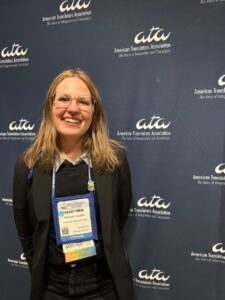 Martina Capelle is a Certified translator (English – Spanish) graduated from the University of Buenos Aires. She works as a freelance translator and interpreter and has over 3 years of hands-on experience as an over-the-phone and video-remote medical interpreter. As of 2026, Martina will be pursuing her postgraduate studies in consecutive & simultaneous interpreting. Martina offers translation, interpreting, proofreading and editing, and MTPE services and is specialized in the legal, economics & finance and medical fields. The American Translators Association represents almost 9,000 translators and interpreters in more than 100 countries. To hire a translation or interpreting professional, please visit www.atanet.org/directory.
 ATA’s Mastermind Program uses a peer-based mentoring approach offering a combination of brainstorming, education, and support. Each year, the program connects members from various fields and language pairs for the purpose of holding virtual discussions on specific topics.
Instead of a teacher presenting content, group members hold each other accountable for achieving specific goals. Every meeting follows a defined outline, which helps to share time fairly and ensures equal speaking time for all attendees.

Take full control of DeepL, ChatGPT, and integrated medical dictionaries to deliver medical translations that meet the highest standards of accuracy and consistency. As a medical translator, you know that…
Participants will learn about the sworn translation process in Italy, which has become much more complicated post-pandemic. The presentation will be in Italian.
Let’s take a break together! Sometimes the world feels a little heavy and, in moments like these, community matters even more. Whether you’re a longtime member or simply curious to…

Get a refresher on all the benefits of your ATA membership! ATA is continuously working to add more benefits for our members. In fact, there are so many, even longtime…

Bring your snorkels and join the Business Practices Education Committee for a deep dive into one business topic! We will discuss contracts for language professionals. Bring your questions, ideas, and…

This space is dedicated to celebrating the accomplishments of our members!
Eriksen Translations Inc. has been recognized by CSA Research as one of the top language services providers worldwide, ranking #64 globally and #19 in North America.
Submit Your Member News!
Do you have news to share with us? If so, you might be featured on our social media channels.


Unlock Your Potential: Join the ATA Mentoring Program
I admit to feeling a bit queasy the first time Hannah and I met. Not because of Hannah – she’s friendly, approachable, and altogether a delightful person. Rather, I worried…

Embracing the Future: Why New Translators and Interpreters Should See AI as an Ally, Not a Threat
As artificial intelligence (AI) continues to transform industries, many translators and interpreters are asking themselves: Is there still a place for me? The answer is a resounding yes, but it…


Translators as Cultural Consultants: Why We Bridge More than the Language Gap
When clients talk to translators about a translation, the first question is usually about accuracy. Is the terminology correct? Does it say the same thing as the original? Those questions…

E116: Get to Know AFTI
Learn about the history of AFTI, the awards and scholarships they offer, and the many ways they support language professionals.

The ATA Chronicle
ATA’s flagship publication since 1972 The ATA Chronicle is the official publication of the American Translators Association. Published six times per year, each issue offers resources and practical solutions to…
Free Monthly Webinar
ATA offers members a free webinar each month, available on-demand for 30 days. Don't miss this month's freebie!

Preventing Burnout in Healthcare for Translators and Interpreters
Explore research-backed strategies to manage stress, prevent burnout, and build a resilient, high-performance culture that improves both personal well-being and patient safety. This webinar offers a comprehensive and transformative learning…



Issues of Newsbriefs
Get the Member Advantage
ATA members are ready for any challenge with the support of a collaborative community, effective education, and 24/7 promotion in ATA’s Language Services Directory.
Get Noticed!
Advertise in Newsbriefs to reach ATA members each month. Consistently high open rates guarantee your advertising will be seen by thousands of professionals!