
What's Happening Now?
ATA provides a snapshot of the current news, events, articles, podcasts, and more. ATA members receive a monthly e-newsletter that highlights this vital information.
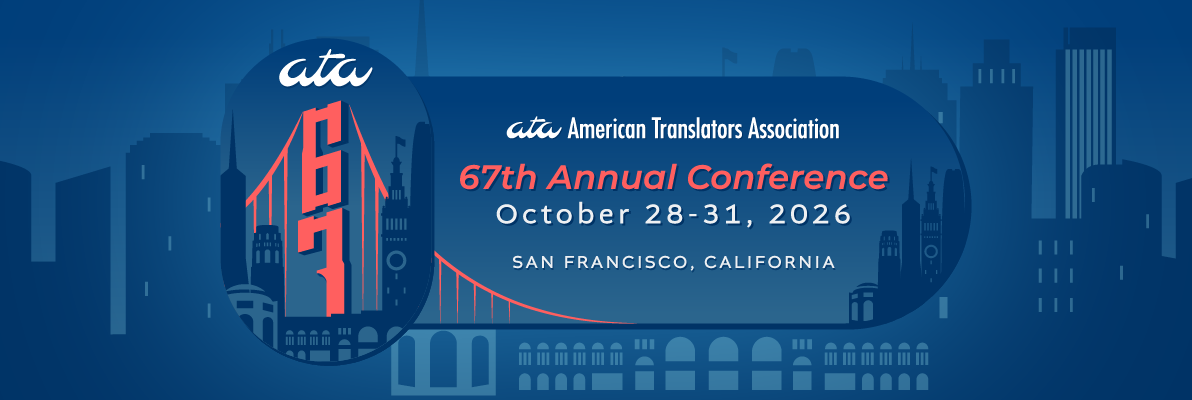
Call for Speakers
ATA is still accepting session proposals for ATA67. We seek advanced, specialized, relevant, and original content that will give attendees an edge in their careers, set them apart from the competition, and provide an advantage over AI. You’ll find the full list of session topics and descriptions on the ATA67 website.
Open to Everyone
You do not have to be an ATA member to submit a proposal.
By contributing to the advancement of your profession, you will build your reputation and résumé, widen your networking circle, and position yourself as a key player to help shape the future of the T&I industry.
Proposals will be chosen through a competitive peer-review process. The Conference Organizer, along with experts in the relevant language and subject area, will assess each proposal’s relevance and its potential to engage the audience and stimulate discussion.
Need More Information?
If you have any questions, please contact Cat Kenol, Senior Professional Development and Events Coordinator at ataspeakers@atanet.org.

As artificial intelligence (AI) continues to transform industries, many translators and interpreters are asking themselves: Is there still a place for me? The answer is a resounding yes, but it comes with an important caveat. The future of translation and interpretation belongs to those who can do what machines cannot, that is, bring cultural competence, empathy, and context to language. At least, thus far.
Cultural competence has always been at the heart of effective communication. It enables professionals to interpret meaning beyond words, including humor, idioms, tone, and intention within specific cultural frameworks. While AI can process vast amounts of linguistic data, it struggles to grasp subtleties that depend on cultural context. This is where translators and interpreters have an invaluable advantage. Those of us in the older generations also bring valuable experience. However, newcomers benefit from growing up with technology, which can further enhance their work.
For example, when an English speaker says, “break a leg,” AI systems often render it literally in other languages. A culturally competent Haitian Creole translator would instead express the sentiment as “Bòn chans” (good luck), understanding that the phrase conveys encouragement, not harm. Similarly, a French translator would know that “I’m feeling blue” should be adapted to “J’ai le cafard,” an idiomatic way to express sadness, rather than a literal reference to color. In Spanish, the expression “It’s raining cats and dogs” continues to challenge AI, which tends to translate it literally, while a skilled human translator would naturally render it as “Está lloviendo a cántaros” to convey the intended meaning. Each of these examples reveals that human translators bring cultural and emotional intelligence that no algorithm can replicate.
Rather than viewing AI as competition, emerging language professionals can embrace it as a collaborator. AI tools can handle repetitive or technical aspects of translation, freeing humans to focus on the higher-level work that requires cultural insight and critical thinking. When used thoughtfully, AI becomes a partner that enhances accuracy and efficiency, while human expertise ensures authenticity, respect, and connection.
Exercises and discussions on cultural competence in the age of AI illustrate exactly how this partnership can thrive. By examining real-world examples of AI-generated translations that miss cultural nuances, practitioners can apply their expertise to refine and humanize the output. These kinds of activities demonstrate an important reality: AI is not replacing translators or interpreters; it is expanding the tools available to them. Simply put, in the age of AI, human translators and interpreters remain essential; not only to navigate the subtle shades of expression, such as “maybe” versus “perhaps,” as highlighted by William Weaver, or the seemingly straightforward choice between “mouse” and “rat,” as noted by Umberto Eco; but also to guide and train AI in recognizing these nuances.
For newcomers to the profession, this era offers unprecedented opportunity. Translators and interpreters who understand both technology and culture will be in high demand. Their role will evolve from language conversion to cultural mediation and AI optimization that will help shape tools that better serve diverse communities. By contributing their expertise to dataset development, cultural annotation, and linguistic validation, translators can directly influence how AI learns and interprets meaning across cultures.
Embracing AI means taking ownership of the field’s future. By guiding technology with cultural competence, new professionals ensure that translation and interpretation remain deeply human endeavors. The machines may translate the words, but only people can truly convey the meaning behind them. As AI continues to evolve, its success will depend on collaboration with culturally-aware professionals who understand that language is not just data—it is humanity in motion.
About the Author

Safira Amazan is a seasoned linguist and communication specialist with extensive experience in legal, medical, and marketing translation and interpreting. Fluent in English, French, Haitian Creole, and Spanish, she bridges linguistic and cultural gaps with precision and cultural insight. She is the Founder and Director of Language and Cross-Cultural Programs at Cultures Communicate, where she provides translation, localization, voice-over services, cultural competence training, and human rights education. Safira holds a master’s degree in legal translation from NYU, she is a certified medical interpreter, and she completed advanced studies in International Law and Cultural Competence.
Contact: safira@culturescommunicate.com
ATA actively works with government agencies and organizations on the issues that affect you. Through ATA's advocacy efforts, you will benefit from the success we achieve together. Being an ATA member supports these efforts.

The government of New Brunswick, Canada, has entered the world of artificial intelligence (AI) with the implementation of a website called ChatGNB that’s available exclusively for government employees.
While there aren’t many details on exactly how it’s being used, the Department of Finance and Treasury Board, which has been piloting the program for the past year, said it’s mainly being used for translating internal documents. But this has some translators concerned.
“There are certain ethical considerations here that we should take into account, because translators fear that they may lose jobs, or that their source of income may diminish,” said Sergey Petrov, a certified translator and the president of the Corporation of Translators, Terminologists and Interpreters of New Brunswick.
Petrov said many of the corporation’s 110 members are individual contractors, and some may get less work if AI is used in their place. “It can make your work a lot easier, but there are some valid concerns,” he said.
Government officials said ChatGNB was created with the support of the Office of the Chief Information Officer and that it’s being used because it’s more private and secure than other AI models out there. “The tool was developed to address the need for meeting privacy and security requirements not previously available from commercial services, while safely exploring benefits from AI,” said a statement from a representative with the Department of Finance.
The Department of Finance said that documents like collective agreements, contracts, policies, and external-facing documents will continue to be translated by Service New Brunswick’s translation services, even as AI develops.
Petrov said the government told the corporation that “employees are encouraged to review translations for accuracy and formatting.” But he doesn’t think that guideline goes far enough and said the corporation will be issuing a formal statement suggesting the government require AI translations to be reviewed and corrected by a real human.
“For me, this is an immediate red flag,” Petrov said. “Because if you want to produce something that’s intended for public use, or that has a serious nature such as legal documents, legally binding documents, or technical documentation or commercial documentation without a review, you are set for trouble sooner or later.”
Petrov said he thinks ChatGNB will open the door for AI to be used for more tasks. “There should be a human being in charge who can be held responsible for what they produce.”
CBC News (1/29/26) By Victoria Walton
Following a multistate demand letter to the Federal Communications Commission (FCC) in November 2025 led by New York Attorney General Letitia James, the FCC has published a long-delayed Multilingual Alerts Order in the Federal Register requiring the expansion of cell phone emergency alerts to include American Sign Language and 13 additional languages.
Wireless Emergency Alerts are short, text message-like alerts sent by government agencies through cell carriers to warn the public of imminent threats, including severe weather, natural disasters, missing persons, and other public safety emergencies. These alerts are among the most widely used public warning tools in the U.S., but for years were issued only in English, with Spanish only supported more recently.
Wireless carriers now have until June 12, 2028, to update their systems to support multilingual alerts in Arabic, Chinese (Simplified and Traditional), French, German, Haitian Creole, Hindi, Italian, Korean, Portuguese, Russian, Spanish, Tagalog, and Vietnamese, as well as American Sign Language. This expansion will benefit an estimated 1.3 million New Yorkers statewide who are not proficient in either English or Spanish and will now be able to access critical, life-saving information during emergencies.
“This is a profound victory for the millions of New Yorkers and families across the country who will no longer be left without guidance during emergencies and natural disasters,” said Attorney General James in a statement. “No one’s ability to protect themselves and their loved ones should depend on the language they speak. I am proud to have stood with my fellow attorneys general and advocates nationwide to push this rule forward. This language expansion will save lives.”
Office of the New York State Attorney (1/21/26)
The Florida Department of Highway Safety and Motor Vehicles (FLHSMV) has announced that all driver’s license tests will now only be issued in English.
FLHSMV said they are implementing the change statewide and will no longer allow interpreters for any of the oral exams or the printed tests. The change began on February 6 and will apply to all driver license classifications, including oral exams, FLHSMV said.
Previously, knowledge exams for most non-commercial driver license classifications were offered in multiple languages, while commercial learner’s permit and commercial driver license knowledge exams were only available in English and Spanish. Under the updated policy, all driver’s license knowledge and skills testing will be conducted in English.
To implement this change, FLHSMV has updated its driver license testing system statewide. Any printed exams in languages other than English will be removed from use.
“FLHSMV remains committed to ensuring safe roadways for all Floridians and visitors by promoting clear communication, understanding of traffic laws, and responsible driving behavior,” the department said in a statement.
CBS Miami (2/5/26) By Ana Maria Soler
A new bill would help Colorado students get recognition at graduation for being fluent in more than one language.
Colorado lawmakers established a process in 2017 for districts to create a seal of biliteracy to be awarded at graduation. Students earn the endorsement if they show proficiency in English and another language through grades and tests.
House Bill 1028, which passed the House Education Committee, states that only 55 of Colorado’s 179 school districts offer a biliteracy seal. This disproportionately leaves out students in rural districts or small schools. The bill creates a new bilingualism diploma endorsement and expands the ability of schools to offer biliteracy and the new bilingualism endorsements.
Students in districts that haven’t created their own endorsement would still need good grades and to take tests measuring competency in English and another language. They would be able to work with a college, university, or a Colorado Department of Education-approved educational nonprofit partner to receive an endorsement.
State Representative Elizabeth Velasco said bilingual students live in every corner of the state, but too many can’t showcase their mastery. The endorsements help demonstrate students’ abilities to employers and colleges. “We want to make sure that kids are able to elevate their skills no matter where they live.”
The bill would require the Colorado Department of Education to set uniform statewide educational requirements for the bilingualism endorsement. Districts that don’t have a program could work with a college or educational non-profit for a fee.
Jorge Garcia, chair and chief executive officer of the Colorado Association for Bilingual Education, said during committee testimony that the current seal has helped students access scholarships and get the recognition they deserve for their abilities. His organization supported the 2017 law.
“In the spirit of continuous improvement, we see the opportunity for us to go even farther, the opportunity to increase access,” Garcia said.
Chalkbeat (2/5/26) By Jason Gonzales
More T&I News
New Book Focuses on a Queer, Black, WWII-Era Translator Who Risked Safety for Love | NPR
New Sign Language Laws Will “Change Lives" | BBC
Doctoral Student to Translate English Professor’s Banned Novel from Persian to English | Binghamton University
Deaf Patients Condemn Lack of NHS National Health Service Interpreters | BBC
 ATA’s Mastermind Program uses a peer-based mentoring approach offering a combination of brainstorming, education, and support. Each year, the program connects members from various fields and language pairs for the purpose of holding virtual discussions on specific topics.
Instead of a teacher presenting content, group members hold each other accountable for achieving specific goals. Every meeting follows a defined outline, which helps to share time fairly and ensures equal speaking time for all attendees.
 The 2026 Nominating and Leadership Development Committee is pleased to announce the call for nominations from ATA’s membership to fill the following positions:
- Treasurer (one position for a one-year term)
- Director (three positions, each for a three-year term)
The elections will be held online. Voting members will be sent their proxy voting information in early October.
Who Is Eligible to be Nominated?
Under ATA’s Bylaws, all Active members of ATA are eligible to run for elected office. Active members are those who have passed an ATA certification exam or who are established as having achieved professional status through Active Membership Review or through the Credentialed Interpreter recognition process.
Active members must be citizens or permanent residents of the U.S. Other member categories are not eligible to serve as officers or directors. However, any member may submit a nomination.
Members of the Nominating and Leadership Development Committee are not eligible to run for elected office.
Submitting Your Nomination
Any ATA member may submit a nomination. Self-nominations are also permitted and encouraged.
Members may make a nomination using the online form on the elections page. Nominations should be submitted as early as possible so the Nominating and Leadership Development Committee can fully consider proposed candidates.

Elevate your skills, build professional confidence, and advance your career by learning the language of modern oncology. Medical interpreters and translators often work with cancer-related terminology on a regular basis.…
Join the Government Division’s leadership council and division members for an informal networking session. The GovD is open to all linguists and administrators in government, at all levels—federal, state, and…

By popular demand (at least, the demand of those who attended the first session), ATA invites you to join our Business Book Club! We’ll read and discuss Devora Zack’s Networking…
The Membership Development Committee develops and supports initiatives aimed at membership growth and retention. Learn more about the Membership Development Committee. This is a closed meeting for committee members only.…

By contributing to the advancement of your profession, you will build your reputation and résumé, widen your networking circle, and position yourself as a key player to help shape the…

This space is dedicated to celebrating the accomplishments of our members!
Élise Hendrick’s first full-length English translation of Aleksandra Kollontai’s 1909 book, The Social Basis of the Female Question, has been released in book form by Haymarket Books.
Submit Your Member News!
Do you have news to share with us? If so, you might be featured on our social media channels.


A (Former) Boston Local’s List of Things to Check Out Around ATA66
This post is a reblog, originally published on Olivia Caputo’s blog. It has been republished with permission from the author. I’m looking forward to my first ATA conference in Boston…

Embracing the Future: Why New Translators and Interpreters Should See AI as an Ally, Not a Threat
As artificial intelligence (AI) continues to transform industries, many translators and interpreters are asking themselves: Is there still a place for me? The answer is a resounding yes, but it…

From Roncando to the Record: Best Practices for Forensic Transcription/Translation (FTT)
At 2:09 p.m. on October 29, 2024, Damian Valdez-Galloso, a Cuban man living in Hialeah, Florida, was interrogated by a Miami homicide detective for allegedly killing Jose Manuel Carbajal Zaldivar,…

E116: Get to Know AFTI
Learn about the history of AFTI, the awards and scholarships they offer, and the many ways they support language professionals.

The ATA Chronicle
ATA’s flagship publication since 1972 The ATA Chronicle is the official publication of the American Translators Association. Published six times per year, each issue offers resources and practical solutions to…
Free Monthly Webinar
ATA offers members a free webinar each month, available on-demand for 30 days. Don't miss this month's freebie!

Preventing Burnout in Healthcare for Translators and Interpreters
Explore research-backed strategies to manage stress, prevent burnout, and build a resilient, high-performance culture that improves both personal well-being and patient safety. This webinar offers a comprehensive and transformative learning…



Issues of Newsbriefs
Get the Member Advantage
ATA members are ready for any challenge with the support of a collaborative community, effective education, and 24/7 promotion in ATA’s Language Services Directory.
Get Noticed!
Advertise in Newsbriefs to reach ATA members each month. Consistently high open rates guarantee your advertising will be seen by thousands of professionals!